For Malatya’s Apricot Stores, Garment Workshops and Public Buildings · Turkey

Private Security Company in Malatya

Titan Savunma is a private security company in Malatya serving dried-apricot processing and storage sites, textile and garment factories, public buildings, and hospitals and places of education; it works under an operating licence issued by the Ministry of the Interior under Law No. 5188. When weighing up the security companies in Malatya, the first thing to look at is who will answer for the site once the contract is signed. With us that person is our Malatya City Manager, who walks your premises for the survey, selects the officers and builds the team, and runs daily supervision and every conversation with you. That local role is backed by two tiers, the Eastern Anatolia Regional Directorate with its centre in Erzurum and, above it, the Ankara General Directorate, which contribute planning support, unannounced inspections, shared training content and a single reporting format. The duty plans themselves are shaped by Malatya’s own conditions: the storage and shipping routine of a province that grows more than half of Turkey’s apricots, garment workshops running busy shifts, the clear weight of public employers, and winter nights that drop below freezing.

Private Security Company in Malatya

Service Scope

The Kinds of Site We Secure in Malatya

The 2025 social security yearbook lists 14,829 workplaces and 149,687 compulsorily insured employees in Malatya, placing it 25th of Turkey’s 81 provinces. Manufacturing accounts for 29,323 of them, or 19.6% of jobs in the province, and 54% of that manufacturing workforce is in textiles and clothing. Food manufacturing, with 613 workplaces, has more sites than any other manufacturing sector, and dried-apricot processing falls within it. With 17.3% of insured employees at public-sector workplaces (Turkey: 12.5%), public buildings, hospitals and schools are also a large part of the picture. We arrange our services under four headings that fit this structure.

Apricot Processing and Warehouse Security in Malatya

At sites where dried apricots are sorted, packed and held in stock for months, we watch store doors, the weighbridge and loading area, and the exit record for export shipments under a single routine.

Textile and Garment Factory Security in Malatya

At sewing and fabric workshops where hundreds of staff arrive and leave at the same hour, we plan the shift gate, fabric and finished-goods stores and night rounds focused on fire.

Public and Service Building Security in Malatya

At public service buildings with a steady flow of citizens all day, we set up reception and guidance, after-hours lock and alarm checks, and posts that follow the institution’s own specification.

Hospital and Education Site Security in Malatya

At hospitals, campuses and schools we deploy unarmed officers only, as Article 8 of Law No. 5188 requires, with separate posts for the emergency entrance, visiting hours and the start-of-term crowd.

A Planned Start

How the Service Is Planned

Before quoting for a site in Malatya, we settle three points with you: when goods and people move in and out of the site most heavily, who will be in charge of the team on the ground, and in what form each shift’s record will reach you.

  1. A Survey at Shift Change and After Dark

    Our Malatya City Manager sees your site once at shift change and once after dark, noting on the spot the gates, loading ramp, store doors, fence line and the places where lighting falls short.

  2. The File for the Governorship of Malatya

    The permit application to the Governorship of Malatya is made in the client’s name, not the security company’s. Our City Manager gathers the commission’s paperwork alongside your staff and reviews it for gaps before submission.

  3. The Team, Post Orders and Supervisor

    The City Manager decides how many officers stand at each post and at what hours, writes the orders around your shipping and production calendar and runs the team day to day in person. A site staffed by fifteen officers or more also gets its legally required security supervisor named here.

  4. Independent Inspector Visits and a Month-End Report

    Daily checks are carried out by the City Manager. Inspectors from the regional tier in Erzurum and from the General Directorate in Ankara confirm that they really take place, turning up without warning on some of their visits. Each month closes with one report listing the findings and which items are settled or still open.

Your Sector’s Priorities

On-the-Ground Management in Malatya, Backed by Our Erzurum-Based Regional Directorate and Ankara General Directorate

Public employers carry unusual weight in Malatya. According to the 2025 social security yearbook, the province’s 563 public-sector workplaces employ 25,916 compulsorily insured people, 17.3% of the total and well above the Turkish average of 12.5%. Once civil servants are counted as well, about 36% of employees in the province work in the public sector, against 28.1% nationally. Public administration’s share of jobs in Malatya is more than two and a half times the national figure. On the other side, 14,266 private workplaces carry the province’s production, with apricots and garments in the lead. With such a mixed set of buyers, the quality of a security service depends on the specification or contract being applied on site with the same care every day. In Malatya that responsibility belongs to our City Manager, supported by two tiers: the regional directorate that oversees the Eastern Anatolia provinces from its base in Erzurum, and our Ankara General Directorate. Those tiers contribute advice while the plan is drawn up, inspection that does not depend on local management, uniform training across teams and one report format across sites.

Law Enforcement Background

The professional experience and security training of retired law enforcement personnel within our team contribute to our approach.

  • Plate, Seal and Paperwork Matched on Every Shipment

    Every load of dried apricots leaving the store is logged on one line with the vehicle plate, seal number and dispatch document.

  • Outdoor Posts Prepared for Winter Nights

    A heated booth, a patrol route chosen with ice in mind and shorter duty spells in the cold are written into the orders.

  • Deadline Tracking for Notices to the Governorship of Malatya

    The contract copy and officer starts and departures reach the Governorship of Malatya before the statutory periods run out.

For International Companies

For international brands in Turkey, we offer a single point of contact, a written scope and regular reporting. Work with us as your security partner

Expert View and Recommendations

The apricot season, the shift gate and winter conditions when choosing a security firm in Malatya

The questions a business or institution in Malatya asks about security usually come from the province’s economic make-up: how are dried apricots that sit in stock for months protected in the store, and on what record does an export load leave through the gate? How is order kept at a garment workshop gate that hundreds of people pass through at once? In a province where the public sector weighs so heavily, how does a service bound by a specification stay consistent on site? Add to these what it takes to stand an outdoor post on hard winter nights. In the six sections below we open each topic with an official figure and then explain what that figure means for gates, stores and patrol routes, with Law No. 5188 setting the framework throughout.

Research we draw on (5)
  1. 5188 sayılı Özel Güvenlik Hizmetlerine Dair Kanun — Mevzuat Bilgi Sistemi
  2. Özel Güvenlik Hizmetlerine Dair Kanunun Uygulanmasına İlişkin Yönetmelik (Mevzuat Bilgi Sistemi, güncel metin)
  3. SGK İstatistik Yıllığı 2025
  4. Tarım ve Orman Bakanlığı — Malatya kayısısı açıklaması (17.07.2026)
  5. Meteoroloji Genel Müdürlüğü — Malatya il istatistikleri

Malatya, the centre of Turkish apricots: store and shipping security from harvest to export

According to a statement by the Ministry of Agriculture and Forestry in July 2026, 54% of Turkey’s apricot production comes from Malatya. In the same statement the Ministry notes that the province hosts an Apricot Research Institute and that Malatya has 53 products with a geographical indication, apricots among them. According to a statement by the Malatya Commodity Exchange in January 2026, 47,699 tonnes of dried apricots were exported from the province in 2025, earning 303.6 million dollars. In the 2025 social security data, food manufacturing has more workplaces than any other manufacturing sector in the province, with 613.

At sites where the dried product stays in stock for a long time and is sent abroad in batches, the security plan rests on these lines:

  • Produce reception: Keeping the grower’s vehicle plate, weighbridge ticket and delivery time in one record, and stopping queuing vehicles from blocking the site road
  • Stores: Door, lock and seal checks out of hours, with entry limited to the operator’s authorisation list
  • Export shipments: Matching container and lorry seal numbers to the dispatch document, and logging the exit time once loading ends
  • Drying and processing area: Noting on night rounds that fire hose cabinets, the space around electrical panels and escape routes are clear

During the survey we work out the season calendar together, using the operator’s shipping records from past years, and write the extra posts for the busy weeks into the contract with start and end dates. Weighing, grading and counting the stock lie outside the security role.

Textiles and clothing: more than half of manufacturing jobs, and crowded shift gates

According to the 2025 social security yearbook, 11,151 insured people work at 241 workplaces in clothing manufacturing in Malatya, and 4,601 at 102 workplaces in textile manufacturing. Together the two sectors reach 15,752 people and make up 54% of manufacturing jobs in the province. By number of insured employees Malatya ranks 8th in Turkey in clothing and 12th in textiles, and clothing carries roughly 2.5 times the weight in Malatya’s jobs that it has across Turkey.

At garment and textile sites the security plan concentrates on three points:

  • Shift gate: Turnstile arrangements at arrival and departure times, access according to the operator’s authorisation list, and the operator’s own procedure for staff who arrive late or without a card
  • Fabric and finished-goods store: Door and seal checks out of hours, matching outgoing boxes to vehicle and paperwork, and a separate record for waste and returns
  • Fire precautions: Night rounds through areas packed with fabric, yarn and packaging; checking that fire doors are shut and escape routes open; the order of people to call if smoke or a smell of burning is noticed

The operator decides who may come through the gate and whether bags are checked, and these rules are copied word for word into the orders. The officer applies them and reports breaches; disciplinary and employment matters belong to the employer.

A province led by public employers: service buildings, specifications and consistency

The 2025 social security yearbook lists 6,946 insured employees at 104 workplaces in public administration in Malatya; this sector’s share of jobs in the province is 2.55 times the national average, ranking Malatya 10th in Turkey. Public-sector workplaces employ 17.3% of all compulsorily insured people, and with civil servants added about 36% of employees work in the public sector. Membership organisations account for a further 1,274 insured people at 87 workplaces.

At service buildings that citizens come and go from all day, security is mostly a matter of order and guidance:

  • Reception: Directing visitors to the right department, keeping the queue in the waiting area and staying calm in tense moments
  • The institution’s admission rules: Practices such as visitor registration, checks for prohibited items or scanning equipment rest on the institution’s written instructions and the relevant legislation
  • After hours: Floor-by-floor checks of doors, windows, locks and alarms, with a key handover log
  • Car park and surroundings: Protecting official vehicle areas and checking daily that the camera recorder is working

For public bodies the scope of the service is usually set out in a specification. We prepare a matching table showing which post and which record meets each clause of the specification, and lay out the monthly report against that table, so the administration’s own inspectors can check the site with the same document.

Hospitals, campuses and schools: unarmed teams and a clear reporting chain

According to 2025 social security data, 7,087 insured people work at 339 workplaces in human health services in Malatya and 5,228 at 307 workplaces in education, with a further 518 registered at 17 residential care workplaces. These figures leave out health and education staff with civil-servant status, so the institutions are in fact larger. Hospitals, higher-education campuses, schools and care homes hold a steady place in the province’s demand for security.

Article 8 of Law No. 5188 does not allow officers to carry weapons at educational and health facilities, so we staff these sites with unarmed teams only. The main points:

  • Hospital: Running the emergency entrance separately from the other doors, keeping the ambulance lane clear at all times, guidance at ward entrances during visiting hours, and officers able to keep worried relatives calm
  • Campus: A separate log for each gate on campuses with several entrances, patrols at changing times in the evening and at weekends, and staffing raised at the start of term
  • Schools and care homes: Gate routines at arrival and departure times, the admission procedure set by the institution for parents and visitors, and night checks at care homes

Patient admission, medical treatment and student discipline lie outside the security role. With the institution’s management we put in writing which department is called for which kind of incident, and practise it with the team during drills.

Mines, quarries and energy sites: perimeter security at remote locations

According to the 2025 social security yearbook, 771 insured people work at 26 workplaces in metal ore mining in Malatya; this sector’s share of jobs in the province is about 2.7 times the national average. The other mining sector, which includes quarrying, accounts for 744 insured people at 70 workplaces. Power, gas and steam supply employs 1,047 people at 114 workplaces. Several such operations are remote, covering large stretches of rough terrain.

At a remote site the security plan relies on these elements:

  • Site entrance: Recording every worker, contractor and vehicle that comes in, and checking paperwork when materials and equipment go out
  • Perimeter: Patrols at changing times and on changing routes, with photo reports of faults in fences, gates and lighting
  • Fuel and spare-parts store: Lock and seal checks out of hours, with a record of everything handed in and out
  • Lone working: Status calls at set intervals and the steps to take if no answer comes; handovers planned ahead in case winter weather closes the road

At quarries and mines our team covers administrative buildings, stores, vehicle entrances and perimeter security; blasting, production and technical occupational safety work belong to the operator’s authorised staff. Around transformers and switchgear, officers observe and raise the alarm but never touch the equipment.

Winter conditions, emergency planning and the Governorship of Malatya; our City Manager and Eastern Anatolia Regional Directorate

At the meteorological service’s central Malatya station, which has kept records since 1929, the January mean is −0.2 °C, the lowest temperature measured is −22.2 °C and the deepest snow recorded is 67 cm. Summers are dry and hot: the July mean is 27.1 °C, that month’s mean maximum is 34.0 °C and the hottest day measured reached 42.7 °C. Because of these two extremes our orders for outdoor posts are split by season: in winter a heated booth, non-slip footwear and patrol routes that change with ice; in summer shade, water and shorter duty spells at midday.

At every site, keeping to the operator’s own emergency and business continuity plan, we put the security team’s tasks in writing:

  • In a fire, a long power cut or heavy snow, the person and sequence for raising barriers and opening motorised gates
  • The path along which staff are led to the muster area
  • The entrance reserved for the fire brigade and ambulances
  • Checking the shift roster with the operator so that nobody is left inside

From the first day of the contract we also put the governorship duties on a calendar. A copy of the signed contract must reach the Governorship of Malatya before close of business on day one of the service. Changes in the team, whether an officer arrives or leaves, have to be notified within fifteen days. Once a site has fifteen officers it needs a security supervisor with at least an associate degree. Legal basis: Law No. 5188, Articles 5, 11 and 12; implementing Regulation, Articles 8 and 10.

That calendar belongs to our Malatya City Manager, whose job it is to spot a fault on site and put it right. Our regional tier sits in Erzurum and our General Directorate in Ankara; between them they comment on the plan while it is drafted, send inspectors without alerting local management and fix one yardstick for training and reports. We recruit first among people living in Malatya. Under security and investigation activities (NACE 80) the province records 81 workplaces and 964 insured staff; in-company security units and officers registered elsewhere are not counted there, yet the figure shows that experienced candidates can be found locally.

Before We Speak

Frequently Asked Questions

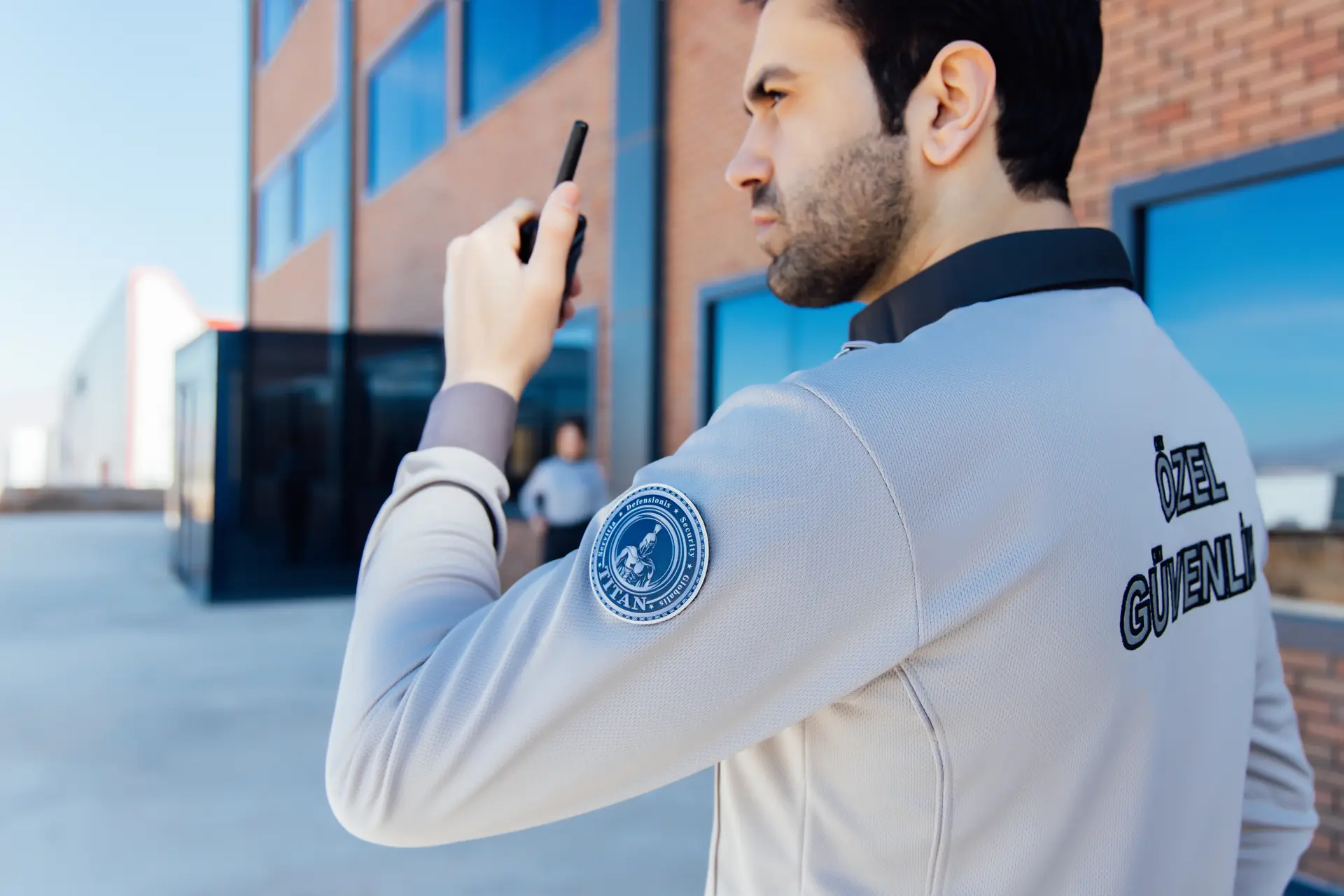
A uniformed Titan Savunma security officer on duty with a radio at an office entrance.
How do we decide which of the security firms in Malatya to work with?

First, ask every candidate to show its Ministry of the Interior operating licence; without it, Law No. 5188 bars a company from offering private security at all. After that, line the bids up against one set of questions rather than the price alone: who leads the team on the ground; how often surprise checks happen and by whom; who stands in when an officer is ill or on leave; how numbers grow during the export season or a production peak; and in what document you will see each of these. Insist on written replies. Ours takes the questions one by one with your particular site in mind.

Who is our day-to-day contact at our site in Malatya?

Our Malatya City Manager. The person who walks your site at the survey stage also builds the team, leads it daily and handles supervision and meetings with you. When you want an extra officer as shipments pick up, when a gate’s opening hours change or when you ask about the outcome of an incident, that is the person you call. The corporate layer consists of the regional directorate for Eastern Anatolia, run from Erzurum, and the Ankara General Directorate: they go over the plan with the City Manager, dispatch inspectors of their own unannounced and set the bar for training and reporting.

Who obtains the private security permit from the Governorship of Malatya, and how does it work?

Not us: the request comes from the institution or company that owns the premises to be guarded. The file is lodged with the Governorship of Malatya; Article 3 of the Law has the provincial private security commission decide on it, and that decision needs the governor’s sign-off. The Regulation gives the commission ten working days. Whether the premises sit in an industrial area, among the apricot orchards or in the town centre, the steps do not change; our City Manager checks with the governorship which papers are currently required and puts the file together alongside you.

How do I apply for a security officer job in Malatya?

Fill in the form on our Careers page and your application lands directly with our Malatya City Manager. At interview we talk through how shifts run at stores, factories, public buildings and hospitals, and what standing an outdoor post means in winter. Article 10 of the Law lists what an officer must meet: Turkish citizenship, a minimum age of 18 and a pass in basic private security training head the list. Once vetting comes back clear, the Governorship of Malatya grants the work permit and the officer’s card, and no one is put on a post before holding both.

How is security tightened at our dried-apricot store when export loads increase?

In the weeks when shipments pick up, more lorries, vans and seasonal workers come and go, and the stock is at its most valuable. During the survey we draw up your shipping calendar with you and plan, for those weeks, a separate officer at the loading ramp, matching of weighbridge tickets against vehicle plates, a record of every container sealed and more frequent night patrols. When the busy spell ends, staffing returns to its normal level, with the dates written into the contract. Officers take no part in weighing, grading or loading.

What measures protect officers at outdoor posts in Malatya’s cold winters?

At the meteorological service’s central Malatya station the January mean is −0.2 °C, the lowest reading has reached −22.2 °C and snow has been recorded at a depth of 67 cm. For store yards, factory gates and outdoor posts at public buildings our orders therefore include a heated booth, winter uniform and gloves, patrol routes kept off icy ground and more frequent changeovers in the coldest hours. After snowfall the first round checks that the space in front of gates and fire exits is clear; clearing it is reported to the operator’s own staff.

How is security organised at a garment workshop with large shifts?

In garment making the risk gathers in two places: the shift gate, which hundreds of people pass through within a few minutes, and the stores holding fabric, trims and finished goods. Who may enter at the gate depends on the operator’s authorisation list; the officer applies that list and the turnstile routine and reports any breach to the supervisor. In the stores, doors and seals are checked after hours, and on night rounds through areas packed with fabric and packaging the officer notes that escape routes and fire hose cabinets are unobstructed. Decisions on bag or personal searches rest on the operator’s rules and the limits of the Law.

Can we ask for armed officers at a hospital or school in Malatya?

No. Under Article 8 of Law No. 5188, officers may not carry weapons in schools, universities or health facilities. What keeps such places safe instead is a careful choice of post locations, CCTV, orderly visitor movement and a calling sequence agreed beforehand with the institution’s own units. According to 2025 social security data, 7,087 insured people work in human health services in Malatya and 5,228 in education; for these sites we give priority to officers who communicate calmly and have experience of guiding crowds.

Get a Duty Plan and Price for Your Malatya Site

Tell us three things on the form: the district or industrial area, how many entrances the site has, and in which months shipments or visitor numbers climb. Our Malatya City Manager then agrees a survey date with you, inspects the premises and follows up with a written duty plan and price, shaped around your shifts, shipping calendar and the Malatya winter.

Request a Security Proposal

Contact

Request a Security Proposal for Your Organisation

Tell us your facility type, location and general requirements. Together, we can define a service scope that suits your organisation.

Tell Us What You Need

Fields marked * are required.

What Happens Next

  1. Initial DiscussionWe respond within 15 minutes and clarify your requirements and facility details together.
  2. Service ScopeWe assess staffing needs and the working arrangements.
  3. ProposalWe prepare our proposal for the agreed service scope.

General Directorates

Ankara · Çankaya
İstanbul · Levent

Nine regional directorates · 81 provinces

Looking for a role? Visit our careers page