For Kars’s Campuses, Hospital, Public Buildings, Hotels and Dairy and Livestock Sites · Turkey

Private Security Company in Kars

Titan Savunma, authorised by the Interior Ministry to provide private security under Law No. 5188, is a private security company whose work in Kars covers university campuses and the university hospital, government service buildings, hotels and the ski slopes, and dairies, abattoirs and livestock farms. If you are deciding between security companies in Kars, start with one question: once the contract is signed, who will actually run our site? Our answer is the Kars City Manager. The City Manager walks your site during the survey, picks and directs the officers, and takes charge of daily checks on every post and of correspondence with your organisation. The City Manager is backed by our Eastern Anatolia Regional Directorate, and the region in turn by our General Directorate in Ankara: a second pair of eyes on the plan, inspections without prior notice, a shared training programme and a uniform report all come from that structure. Each plan we write for Kars grows out of the province’s own picture: more than half of dependent employees working for the state, a university with over twenty thousand students, a livestock economy among Turkey’s top five for cattle, and a winter whose January mean falls below minus ten degrees.

Private Security Company in Kars

Service Scope

The Sites We Protect in Kars

In Kars, the map of security needs becomes clear once you see where jobs are concentrated. SGK’s 2025 yearbook places 37.8% of the province’s 28,046 compulsorily insured employees at public-sector workplaces, against 12.5% for Turkey, which puts Kars fifth of 81 provinces on that measure. Education, health and public administration together employ 24.4% of insured staff, while manufacturing holds just 6.9%, and food production makes up more than half of that small share. Put Kafkas University and its research hospital, public bodies, skiing at Sarıkamış and the dairy and livestock chain side by side, and the service falls into four groups of site.

Hospital and Campus Security in Kars

At Kafkas University’s campus gates, around halls and dining halls, and at the research hospital’s emergency entrance and car park, the Law allows no firearms, so our teams are made up of unarmed officers who know how to settle tempers with words; the emergency door and the ambulance lane each get a post of their own.

Public Building Security in Kars

In public service buildings, the backbone of the plan is order in waiting halls, directing each visitor to the unit they need, a floor-by-floor tour at evening closing, and turning each post named in the specification into its own written instruction.

Hotel and Ski Resort Security in Kars

During the ski season at Sarıkamış we add posts in lobbies, car parks, ski lockers and event spaces; when visitors to the Ani archaeological site are at their busiest we shift hotel rotas in the city to follow check-in and check-out, and once the season closes we watch over empty buildings on patrol.

Dairy, Abattoir and Livestock Farm Security in Kars

At fattening farms and dairies, at the abattoir and meat plant in the organised agricultural zone, at feed stores and at the ramps where cold-chain lorries load, we set up night patrols, a log of vehicles in and out, and a reinforced gate routine on days when livestock is shipped.

A Planned Start

How the Service Is Planned

Before we put a price on a campus, public building, hotel or dairy and livestock site in Kars, we answer three questions with you: at what hour and in which season people or vehicles are heaviest, which posts will be left in the open on the harshest winter days, and in what form the records officers keep should reach you.

  1. A Survey That Reckons with the Frost

    Our Kars City Manager walks your site both at its busiest hour and after closing, and puts the number of gates and ramps, the lighting, what the cameras can see and the posts most exposed to blizzard or ice in winter onto a single sketch plan.

  2. The Permit File for the Governorship of Kars

    It is the client body, not us, that petitions the Governorship of Kars for permission to use private security. Sitting down with you, our City Manager assembles the paperwork the governorship wants and checks it line by line so nothing is missing when the file is handed in.

  3. Building the Team, Writing the Orders

    The people on the roster and the shift leads are the City Manager’s choice, and so is the wording of every post instruction, fitted to your working day, your season or shipping calendar and the winter routine. A team of fifteen or more also needs a security supervisor under the Law, and that appointment is made now as well.

  4. Inspections Without Notice and a Month-End Report

    Checking the posts every day falls to the City Manager. Inspectors appointed by our regional and general directorates, meanwhile, often drop in on the Kars site without notice and look at whether the orders on paper are really being followed at the post. What they find, and what became of each point, lands on your desk in one report at the end of the month.

Your Sector’s Priorities

Local Leadership in Kars: The City Manager on Site, Regional and General Directorates Behind

The 2025 SGK yearbook records 28,046 compulsorily insured employees at 3,798 workplaces in Kars. Between 2024 and 2025 the number of insured workers here climbed 8.2%, against 2.1% nationally, and it has grown by 28.1% since 2016. Some 87.1% of workplaces employ nine people or fewer; just six have 250 staff or more, and together they hold only 8.1% of insured employees, compared with 21.0% nationally. In Kars, then, the large organisations buying security are mostly public bodies, the university and the hospital. In a city of this size, the quality of the service rests on a manager who sees the site with their own eyes each day and puts a faltering routine right without waiting; in Kars our City Manager carries that role. At regional level, our Eastern Anatolia Regional Directorate comments on the plan, schedules training and audits the site with a separate pair of eyes. Our Ankara General Directorate lays down the shape of the report and the rules that apply across the company.

Law Enforcement Background

The professional experience and security training of retired law enforcement personnel within our team contribute to our approach.

  • Short Outdoor Spells Below Zero

    Through the winter months, a heated booth, several layers of clothing and frequent changes of guard go into the orders for every outdoor post.

  • No Post Left Empty, Even in a Blizzard

    Standby officers for days when snow closes the roads, and handover times that can be moved, are written down from the start; the officer on duty never leaves until the replacement is there.

  • The Governorship’s Deadlines, Always Met

    The contract copy, and the record of every officer who joins or leaves, are sent to the Governorship of Kars within the statutory time limits.

For International Companies

For international brands in Turkey, we offer a single point of contact, a written scope and regular reporting. Work with us as your security partner

Expert View and Recommendations

Choosing a security firm in Kars: what public bodies, campuses, livestock sites and the frost demand

The questions an organisation looking for security in Kars asks stem from four features of the province. In a city where the state pays the wages of nearly six in ten dependent employees, how does tender wording end up as the instruction in the pocket of the officer at the barrier? How do people who carry no weapon keep things calm at a four-campus university and at a hospital handling more than sixty-five thousand emergency visits a year? In the province ranked fifth in Turkey for cattle, how are dairies, abattoirs and livestock farms protected? And in a winter that has seen minus thirty-seven degrees, how does an officer at an outdoor post hold out? Each of the six parts that follow takes up one of these issues inside the bounds of Law No. 5188, relying on records from SGK, Kafkas University, the Kars Provincial Directorate of Agriculture and Forestry, the Ministry of Culture and Tourism and the meteorological service.

Research we draw on (8)
  1. 5188 sayılı Özel Güvenlik Hizmetlerine Dair Kanun — Mevzuat Bilgi Sistemi
  2. Özel Güvenlik Hizmetlerine Dair Kanunun Uygulanmasına İlişkin Yönetmelik (Mevzuat Bilgi Sistemi, güncel metin)
  3. SGK İstatistik Yıllığı 2025
  4. Kafkas Üniversitesi — 2024 Yılı İdare Faaliyet Raporu
  5. Kars İl Tarım ve Orman Müdürlüğü — 2025 Yılı İl Faaliyet Raporu
  6. Kars İl Kültür ve Turizm Müdürlüğü — Kış Turizmi ve Kış Sporları
  7. UNESCO Dünya Mirası Merkezi — Ani Arkeolojik Alanı
  8. Meteoroloji Genel Müdürlüğü — Kars il istatistikleri

The public share: from specification to orders at the gate

In SGK’s 2025 figures, state employers account for 37.8% of compulsorily insured employees in Kars; nationwide the proportion is 12.5%, and only four provinces score higher. Count civil servants as well and close to six in ten dependent employees in the province (59.2%) are on the state payroll, where the national level is 28.1%. Kars has 1,366 insured staff in public administration and 1,935 in administrative and business support services, and each of these sectors weighs about 2.5 times more in local jobs than it does in Turkey overall.

Public bodies generally buy security by tender, and the specification frames the work. In that setting our contribution comes down to four headings:

  • Clause-by-clause orders: For every guard position the tender lists, with its hours and staffing, we write a standalone instruction sheet.
  • Waiting halls: In busy service buildings visitors are sent to the right unit and queues are kept in order; the organisation decides what information is recorded at the entrance.
  • Closing time: When staff leave, officers walk past the archive, the plant room and the server room, noting the hour at each locked door.
  • Reports that slot into payment files: We prepare the month-end report so it can be attached to the progress payment file and handed to the internal auditor without reworking.

In public buildings in Kars our officers are not sent to fetch and carry papers or given clerical work; the Law wants them occupied with protection and security alone.

Kafkas University hospital: 286 beds and a busy emergency department

According to Kafkas University’s 2024 Administrative Activity Report, its Health Research and Practice Hospital has 286 beds: 12 emergency, 41 intensive care and 233 ward beds. In 2024 the hospital saw 184,199 outpatients, received 65,885 emergency attendances and carried out 22,107 operations. The 2025 SGK yearbook puts 2,116 insured employees in human health services in the province, a share of local employment 1.4 times the national average.

Armed officers are not kept at health institutions (Law 5188, Art. 8), so our teams work unarmed here. The plan focuses on:

  • Emergency department: A permanent post, communication that lowers tension, and a clear list of whom to call in the hospital’s own order whenever something goes wrong
  • Ambulance entrance: A notification route agreed with the operator in advance so the entrance stays open through snow and ice
  • Intensive care and theatre corridors: Keeping visiting-hour crowds away from these areas
  • Car park and grounds: Directing vehicles, night rounds and adding corners the cameras miss to the patrol route

Appointment queues, treatment decisions and visitor passes for relatives are handled by hospital staff; our officers are there so that this work can happen in a calm corridor inside a protected building.

Four campuses and over twenty thousand students: order at Kafkas University

Kafkas University’s 2024 Administrative Activity Report shows 20,707 students in total: 17,867 in daytime programmes, 1,827 in evening programmes and 1,013 in distance learning. The university teaches across four campuses: the main campus in Kars, the Dereiçi campus and campuses in the Sarıkamış and Kağızman districts, with about 284,000 m² of indoor space on the main site. The Sarıkamış campus houses the Faculty of Tourism and the Faculty of Sport Sciences. In SGK’s 2025 data, education is the province’s largest employer, with 3,360 insured staff, and its share of local employment is roughly 2.9 times the national average.

At a university spread over several campuses, the security plan is shaped by both place and calendar:

  • Orders for each campus: Gates, halls and social facilities differ, so post orders are written separately for each campus.
  • Enrolment and exam weeks: Extra guidance while new students and their families arrive, and reinforced posts at teaching block entrances at exam times
  • Halls and dining halls: Lighting checks and patrols at varying times in the evenings
  • Winter paths: Reporting snow-blocked footpaths and iced steps to campus management straight away

No officer on a campus carries a weapon either (Law 5188, Art. 8). Disciplinary inquiries and student records are handled by the university’s own staff; our officers operate the access routine laid down by the rectorate and pass on anything that breaks it in a written note.

Pasture, cattle and milk: site security along the livestock chain

The Kars Provincial Directorate of Agriculture and Forestry’s 2025 Activity Report records 604,798 cattle in the province, ranking Kars fifth in Turkey, and describes the province as a production centre, with roughly 153,000 head sent out of it. Meadow and pasture cover 418,702 hectares, or 44.3% of the province’s area. The same report states that, as of December 2025, in the 188.05-hectare Kars (Fattening and Dairy) Organised Agricultural Zone 13 fattening plots were at project stage and 2 under construction; 2 milk processing plots had been provisionally allocated, an abattoir and integrated meat plant had completed its investment, and one plot was set aside for a feed mill. SGK’s 2025 data list 156 workplaces and 1,051 insured staff in food manufacturing.

At sites along this chain we build the security plan around the pace of production:

  • Shipping days: An extra officer at the gate, a log of vehicles in and out and order in the waiting area on days when animals and products leave in numbers
  • Stores and cold rooms: The doors of feed, equipment and product stores are checked on rounds with the time written down.
  • Plots under construction: Materials and machinery on sites still being built are guarded by a team that shrinks or grows with the job.
  • Night and winter: Checking lighting at the loading ramp and around the perimeter, and telling the operator when drifts start to bend a fence or jam a gate

The operator and its veterinarian set the rules for entering barns and production areas; the team sees that they are followed. Animal care and production work are never given to security officers.

Skiing at Sarıkamış, Ani and a winter of −37 °C: a team shaped by season and cold

According to SGK’s 2025 data, 1,234 insured employees work at 93 workplaces in accommodation in Kars; the sector’s share of local employment is about 2.4 times the national average. The Ministry of Culture and Tourism’s provincial directorate lists the ski centre at Sarıkamış among the province’s winter tourism assets and gives the best skiing period as early December to early April, and the Ani archaeological site, on UNESCO’s World Heritage List, brings cultural visitors to the city. What guarding those sites involves is spelt out by the meteorological service’s figures for central Kars: a January mean of −10.7 °C, a lowest recorded temperature of −37.0 °C and a deepest logged snow cover of 120 cm, while the July mean is a cool 17.6 °C.

At hotels and ski facilities we divide the year into periods:

  • Ski season: Extra posts in lobbies, car parks, ski lockers and event spaces, with rotas moved to follow arrivals and departures
  • Cultural tourism peaks: Order in lobbies and car parks at city hotels as large groups come and go
  • When the lifts stop: Evening patrols of shuttered hotels and guesthouses, a hand on every door and window, and a call to the owner at the first sign of a burst pipe
  • Cold at outdoor posts: Booths with heaters, thermal layers, boots that grip on ice and spells outside kept short, with lights and cameras checked whenever snow blurs the view

In SGK’s 2025 yearbook, temporary workplaces employ 6,033 insured staff (21.5%, against 14.8% for Turkey), and electricity, gas and steam supply carries 2.6 times the national share of local employment. On the temporary sites of energy and infrastructure work we guard materials and machinery under the same winter routine. Guest registration, room matters and piste safety are the operator’s responsibility; the team keeps order in shared areas.

From permit file to month-end report: the Kars Governorship calendar and our chain of management

In Kars, a private security permit is born of the client organisation’s own petition. Article 3 of Law No. 5188 requires it to be lodged with the Governorship of Kars on behalf of the body that will benefit; the provincial private security commission takes up the request and the governor has the final word. Article 8 of the Regulation aims for the matter to be settled inside ten working days. Supporting paperwork can change, so we advise obtaining the latest list from the governorship before you start assembling anything.

From the moment the posts are manned, we run three deadlines owed to the governorship:

  • First-day delivery: A copy of the contract as signed by both parties reaches the Kars Governorship before working hours end on the first day of service, as Article 5 of the Law and Article 10 of the Regulation require.
  • Fifteen-day window: Anyone added to the roster, taken off it or moved to a new post is notified within that period, under Articles 11 and 12 of the Law and Article 8 of the Regulation.
  • Supervisor rule: When the team reaches fifteen, a security supervisor with an associate degree or above is named (Law, Art. 5).

All three deadlines belong to our Kars City Manager, who also runs the site. Since the same manager carries out the survey, picks the team, checks the posts every day and writes to you, whoever notices a fault is also the one able to put it right. Our Eastern Anatolia Regional Directorate backs that manager’s plan and sends its own inspector to the site unannounced; it answers to our Ankara General Directorate, and training content and reporting benchmarks are the joint work of those two levels.

In building the roster we put residents of Kars first; an officer who has lived through the frost knows what to watch for on an outdoor post. SGK’s 2025 records list the province’s investigation and security activities sector with 26 workplaces and 510 insured staff, a 1.82% share of local insured employment set against 1.51% nationally. Guards kept in-house by organisations, and staff of firms registered in other provinces, do not show up in that number. We put the frequency of checks and surprise visits into the proposal as figures, and the monthly report shows you what turned up.

Before We Speak

Frequently Asked Questions

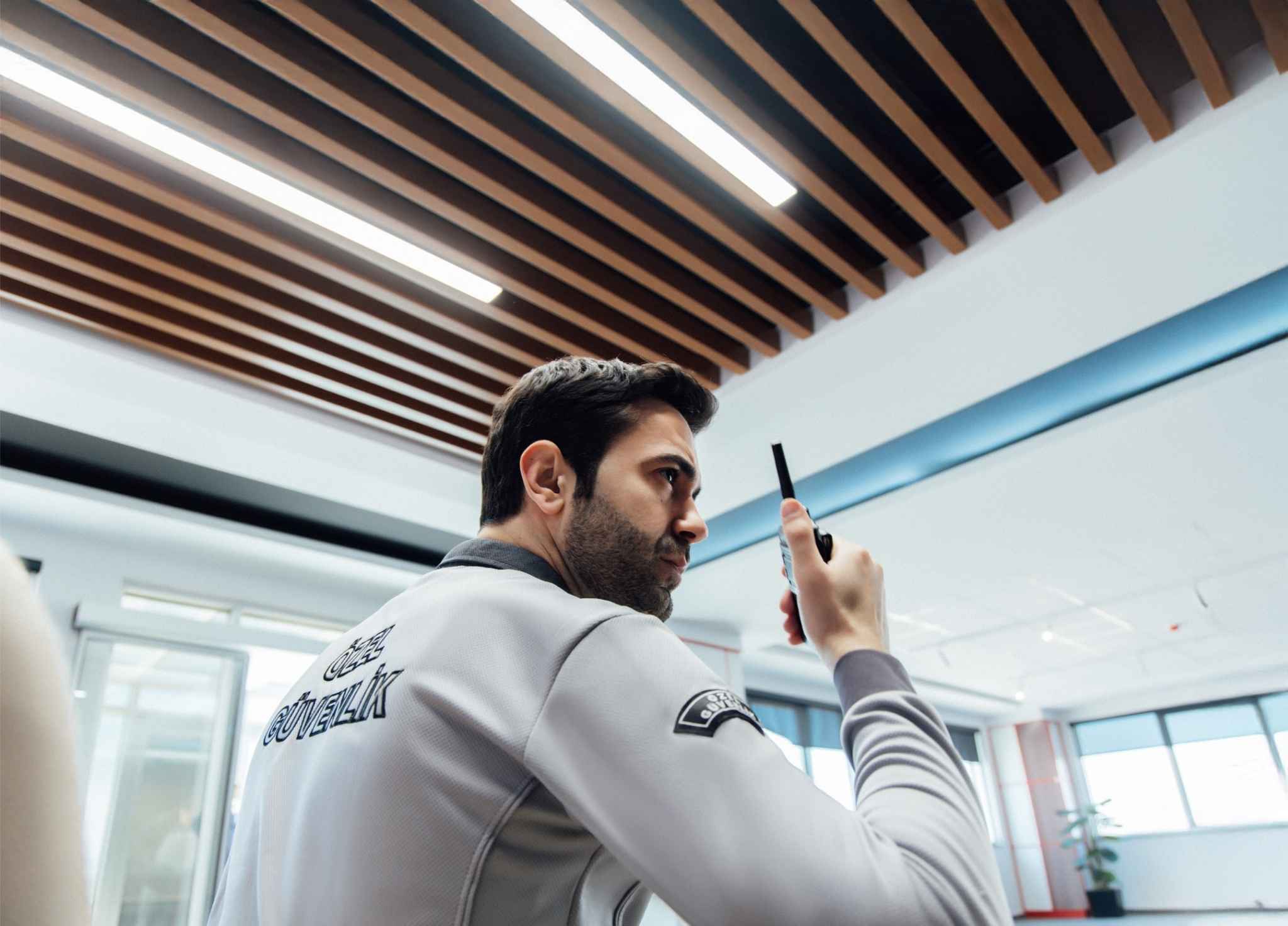
A Titan Savunma officer in a private security uniform communicating by radio inside a building.
How should we choose between security firms in Kars?

Start by asking to see the permit each firm needs from the Interior Ministry to operate under Law No. 5188. After that, put an identical questionnaire to all of them and insist on replies on paper: who manages the Kars team, how often and by whom are surprise visits made, what happens on the morning an officer does not show, what changes on the posts when a blizzard or deep frost sets in, and which report will document the checks? Comparing the written answers also shows what the gaps between prices actually reflect. The university and other public bodies can put most of these questions straight into their specification.

Who will be responsible for our site in Kars, and what stands behind them?

Our Kars City Manager. This is your single point of contact, who walks the site step by step in the survey, forms the team, checks the posts each day and handles your correspondence; whether you want an extra post, need an officer replaced or wonder how an incident was closed, it is this manager’s number you dial. The level supporting the City Manager is our Eastern Anatolia Regional Directorate, with our Ankara General Directorate above it. Reviewing the plan and unannounced site inspections come from the region, while training topics and the shape of the monthly report are agreed by both levels together.

We are a university or public body: how do we obtain the private security permit?

The organisation receiving the service applies in its own name to the Governorship of Kars. The provincial private security commission debates the file, and the permit exists once the governor endorses the commission’s ruling; under the Regulation, ten working days is the ceiling. Since a public body normally procures by tender, its specification already fixes how many posts there are, which shifts run and what the report must contain, and we map every post order onto a clause of it. Our City Manager prepares the permit file with you.

How can I apply to work as a private security officer in Kars?

Applications go in through our Careers page. In Kars, the City Manager decides who works at which site, and talks through the winter posts, night shifts and nature of the work with each candidate. Article 10 of the Law lists the basic qualifications; chief among them are citizenship of the Republic of Turkey, a minimum age of 18 and a pass certificate from the foundation course in private security. Before the first shift, the officer’s work permit and ID card must have been issued by the Governorship of Kars (Law 5188, Arts. 11–12).

What do you do to protect an officer at the gate during a Kars winter?

In the meteorological service’s records for central Kars, the January mean is −10.7 °C and the average January low is −16.2 °C; the lowest reading on record is −37.0 °C and the deepest snow cover logged is 120 cm. In these conditions we recommend, for barrier, gate and car park posts, a warmed shelter sealed against the wind, several layers of winter clothing and non-slip boots, changes of guard at intervals close to hourly, and hot drinks in the booth. Officers tell the operator about iced-over ramps and steps; clearing snow and gritting are the operator’s responsibility.

At the research hospital and on campus, where does the security team’s job end?

The officer’s job is protection: keeping patients and their companions, students, staff and the building safe, letting tension die down before it grows, and logging every incident without delay. A fixed post at the emergency door, an empty ambulance lane, traffic that keeps moving in the car park and an evening round near halls and the dining hall are within that job. Admitting and treating patients, disciplining students and official correspondence are tasks for hospital and university units. Under Article 8 no weapons are carried at health and education institutions, and the teams we assign to them in Kars are unarmed.

How is security planned for our dairy, abattoir or livestock farm?

At these sites, risk gathers around night hours, feed and equipment stores, and shipping days when vehicles crowd in. The plan includes a log of vehicles in and out, timed rounds of store and cold-room doors, lighting at the loading ramp and an extra officer at the gate on days when animals are shipped. The operator and its veterinarian set the rules for entering barns and production areas; the team sees that they are followed and reports breaches. Animal care and production work are never given to security officers. Guarding materials and machinery on plots still under construction can be added to the same contract.

What role does the security team play in our emergency plan?

In Kars, an organisation’s emergency and continuity document should deal with at least four scenarios: fire, flash flooding, snow that shuts roads for days and a power cut lasting hours. The document is drawn up by the organisation itself; we put the lines assigned to our team into practice. Those lines tend to be: opening barriers and gates by hand when the power fails, taking staff and visitors to an assembly point shovelled clear beforehand, helping count from the shift chart whether anyone is left inside, keeping the route for fire engines and ambulances free of parked cars, and making sure no one walks into a damaged section. At every site in Kars we attach these steps to named officers and rehearse them with the same team whenever the organisation holds a drill.

Request a Duty Plan and Price in Writing for Your Kars Site

On the form, simply describe what kind of facility you run, how many gates and ramps it has, your working, visiting or shipping hours, and whether the purchase will go through a tender or a direct agreement. Settle the survey date by phone with our Kars City Manager; after the survey, a duty plan and price written around your site’s conditions, frost and snow included, will be in your hands in writing.

Request a Security Proposal

Contact

Request a Security Proposal for Your Organisation

Tell us your facility type, location and general requirements. Together, we can define a service scope that suits your organisation.

Tell Us What You Need

Fields marked * are required.

What Happens Next

  1. Initial DiscussionWe respond within 15 minutes and clarify your requirements and facility details together.
  2. Service ScopeWe assess staffing needs and the working arrangements.
  3. ProposalWe prepare our proposal for the agreed service scope.

General Directorates

Ankara · Çankaya
İstanbul · Levent

Nine regional directorates · 81 provinces

Looking for a role? Visit our careers page