For Muş’s Garment Factories, Public Buildings, Hospitals, Campuses and Food Plants · Turkey

Private Security Company in Muş

Titan Savunma is a private security company, authorised by the Interior Ministry to trade under Law No. 5188, working for garment factories and sewing workshops, public service buildings, social service centres, hospitals and campuses, and food and farming businesses in Muş. Before settling on one of the security companies in Muş, we suggest asking who will stand at the head of the team on your site and which decisions that person can take alone; our answer is the Muş City Manager. The City Manager is the first to walk round your site, picks and places the officers, checks the shifts every day and handles correspondence with your business. Two layers stand behind that role: our Eastern Anatolia Regional Directorate reviews the plan alongside the City Manager and sends auditors to sites without notice, while our Ankara General Directorate holds training content and report format to one standard. We build each plan on the picture particular to Muş: garment manufacturing as the largest registered employer, more than a third of insured staff working in the public sector, livestock farming spread across a broad plain, a winter whose January mean sits about seven degrees below zero and a summer whose July mean passes 25 degrees.

Private Security Company in Muş

Service Scope

The Sites We Protect in Muş

Two facts together shape security needs in Muş. According to the 2025 SGK yearbook, the province’s largest registered employer is the manufacture of wearing apparel: 4,944 insured workers spread over 80 workplaces, or 14.9% of everyone insured in Muş, a share more than five times the Turkish average. At the same time, 35.9% of insured employees are at public-sector workplaces, and education, health and public administration together account for 27.0%, against 11.3% across Turkey. Add livestock farming and food processing on the plain, and the work divides into four kinds of site.

Garment Factory and Workshop Security in Muş

On shift-based sewing lines we bring together in one plan the flow of staff in and out under the rules the business sets, door records for fabric and finished-goods stores, dispatch checks at the loading bay and building rounds during the night hours when production stops.

Public Building and Social Service Centre Security in Muş

At service buildings we take on getting visitors to the right unit, order in waiting halls and door and window checks when the working day ends; at day-time social service centres, we see that the organisation’s visiting rules are followed and walk the building after closing.

Hospital and Campus Security in Muş

At hospital emergency entrances, outpatient waiting areas, campus gates and in the hours when student numbers swell, the Law allows no firearms, so we work only with unarmed officers who communicate well, and set up the ambulance route and the car park as separate posts.

Food and Agricultural Business Security in Muş

During the sugar beet intake we handle the queue of vehicles at the weighbridge and holding yard, entry routines at dairy plants and feed stores and night patrols around abattoirs and cold stores, with a team that expands and contracts with the season.

A Planned Start

How the Service Is Planned

Before preparing a quote for a factory, public building, hospital or food business in Muş, we work through three questions with you: when does the number of people passing the gate peak at shift changes and visiting hours, which posts are left open to freezing cold in winter and fierce sun in summer, and in what form will the records officers keep reach you.

  1. A Survey That Reads Both Seasons

    Our Muş City Manager tours your site while shifts are changing over and notes, one by one, the gates and loading bays, store entrances, lighting, areas the cameras do not cover and the posts most exposed to snow in winter and sun in summer.

  2. Filing for the Permit in Muş

    The organisation or business that will receive the service submits the permit request to the Governorship of Muş in its own name. Our City Manager assembles with you the paperwork the commission is likely to ask for and checks that nothing is missing before the file goes in.

  3. Forming the Team and the Shift Plan

    Our City Manager selects the officers and shift leads, writes the post instructions around your production shifts, opening hours and the season, and directs the crew day to day. A site needing a headcount of fifteen or above also gets its legally required security supervisor named at this point.

  4. Surprise Checks and a Monthly Report

    Day-to-day control rests with our City Manager. On top of that, auditors working for the regional and general directorates usually turn up at the gate unannounced and look at whether the instructions on paper are really followed at the post. Findings, completed corrections and outstanding items are gathered into one report each month.

Your Sector’s Priorities

Management on the Spot in Muş: Our City Manager and the Structure Behind the Role

The 2025 SGK yearbook shows 3,270 workplaces and 33,252 compulsorily insured employees in Muş. The insured headcount has risen by 73% since 2016, and by 9.8% between 2024 and 2025 alone. Workplaces with fewer than ten staff make up 83% of the total, yet over half of insured staff (51.3%) are concentrated in 125 workplaces with 50 or more employees, and the 13 workplaces with 250 or more account for 17% on their own. On a busy sewing line or in a crowded service building, you need a local manager who can spot a routine slipping on the spot and put it right without delay; in Muş that responsibility lies with our City Manager. Those plans are backed by the regional directorate for Eastern Anatolia, which also audits sites separately from the City Manager and runs training. Templates for reports, and the rules every Titan team follows, come from our Ankara General Directorate.

Law Enforcement Background

The professional experience and security training of retired law enforcement personnel within our team contribute to our approach.

  • Heated Booths in Winter, Shade in Summer

    Winter orders for outside posts specify warm shelter and extra clothing; summer orders add an awning, water and quicker rotation through the hottest hours.

  • An Orderly Gate at Shift Change

    Extra officers are placed at the gate as production shifts start and finish, so staff pass through without crowding under the rule the business sets.

  • Notices to the Governorship of Muş on Time

    The governorship in Muş is sent a copy of the contract, and written word of every officer joining or leaving the roster, before the statutory period runs out.

For International Companies

For international brands in Turkey, we offer a single point of contact, a written scope and regular reporting. Work with us as your security partner

Expert View and Recommendations

Production lines, public buildings and two demanding seasons: choosing a security firm in Muş

The questions a business or public body looking for security in Muş asks depend on how the city earns its living and the climate it works in: in a province where thousands work on sewing lines, how does a shift gate run without jamming? Where over a third of insured jobs sit with the state, what turns a tender document into orders a guard can follow? At a hospital or on a campus, what keeps things calm when no officer may carry a weapon? How is a weighbridge yard managed when the beet campaign fills it? On a plain where the thermometer can swing from minus thirty-four to plus forty-one within a year, how is a guard’s health looked after? Each of the next six sections takes up one of these questions using figures from SGK, the Ministry of Agriculture and Forestry and the state meteorological service, and ties the answer to the duties Law No. 5188 defines.

Research we draw on (5)
  1. 5188 sayılı Özel Güvenlik Hizmetlerine Dair Kanun — Mevzuat Bilgi Sistemi
  2. Özel Güvenlik Hizmetlerine Dair Kanunun Uygulanmasına İlişkin Yönetmelik (Mevzuat Bilgi Sistemi, güncel metin)
  3. SGK İstatistik Yıllığı 2025
  4. T.C. Tarım ve Orman Bakanlığı Muş İl Müdürlüğü — Muş Tarımsal Yatırım Rehberi 2025
  5. Meteoroloji Genel Müdürlüğü — Muş il istatistikleri

Garment manufacturing: factory security in the province’s largest registered employer

According to the 2025 SGK yearbook, Muş has 80 workplaces and 4,944 insured employees in the manufacture of wearing apparel, 14.9% of all insured staff in the province. The sector’s share of local employment is 5.05 times the Turkish average, and by headcount Muş ranks twentieth of the 81 provinces. Manufacturing as a whole, with 7,006 insured employees, makes up 21.1% of provincial employment. That is close to the national figure of 23.8%, whereas in the same year the share stood at 8.7% in Ağrı and 8.6% in Erzurum.

In a factory built around sewing, the security plan follows the rhythm of production:

  • Shift gate: Extra officers are posted when a large workforce enters or leaves within a few minutes; people pass through using the card or list procedure the business defines.
  • Fabric and product stores: Key handovers and door openings at raw material and finished-goods stores are logged, and any opening outside working hours is reported.
  • Loading bay: Times and dispatch paperwork for incoming and outgoing vehicles are noted and matched to the list the business provides.
  • Nights and holidays: When the lines stop, electrical panels, the boiler room and the area around the stores are watched for fire risk on rounds with recorded times.

Officers are not given production, stock-counting or quality control tasks; the team carries out protection and security duties only.

The weight of the public sector and social service centres: from specification to closing rounds

SGK data for 2025 show Muş’s 259 public-sector workplaces employing 11,941 compulsorily insured staff, or 35.9%, compared with 12.5% in Turkey as a whole; Muş ranks seventh among the 81 provinces. Add civil servants and the public payroll covers 56.5% of the province’s employees, compared with 28.1% nationally. Public administration accounts for 2,957 insured employees, a share of local employment 4.89 times the national average. In social work without accommodation, 921 insured employees take the share to roughly six times the national level.

Most of these bodies procure guarding by tender, and what we add falls into four parts:

  • Matching the specification: For every post listed in the tender, we draft its own sheet of orders stating hours and the number of guards.
  • Service buildings: At busy times visitors are directed to the right unit and order is kept in the waiting hall; what gets written down about each visitor is the organisation’s call.
  • Social service centres: At day-time centres, keeping to opening and closing times, applying the organisation’s visiting rules and walking the building after closing; care and counselling remain entirely with the organisation’s staff.
  • Month-end file: Duty, patrol and incident records that the inspection and acceptance committee reviews before payment are summarised in one file.

Carrying documents, switchboard duty and administrative work are not given to officers; the team does protection and security work only.

Health and education institutions: calm order kept by unarmed officers

The 2025 SGK yearbook records 3,803 insured employees at 115 workplaces in education and 2,214 at 97 workplaces in human health services in Muş. Education’s share of local employment is 2.76 times the national average, and health’s 1.24 times. The state university and the hospitals in the city are the main sites in both fields.

Carrying a weapon in hospital and school buildings is not legally possible for an officer (Law 5188, Art. 8); order rests on calm speech and sensible positioning. The plan concentrates on:

  • Emergency department: A separate post, an officer who eases tension by talking, and the reporting order set by hospital management when an incident occurs
  • Outpatients and visiting hours: Order in waiting areas, directions to the right floor and keeping crowds out of intensive care corridors
  • Campus gates and halls: Gate posts reinforced at the start of classes and on exam days, and evening patrols around halls of residence and libraries
  • Winter months: Telling management quickly when snow blocks a footpath, steps ice over or something obstructs the ambulance approach

Admitting patients, clinical guidance, arrangements for companions and student discipline are handled by hospital and university staff; the guards simply keep the surroundings safe.

The plain, livestock and food processing: workloads that change with the season

The Ministry of Agriculture and Forestry’s Muş Agricultural Investment Guide 2025 places the province 15th in Turkey for cattle, 12th for sheep and goats and 6th for water buffalo, and fourth for lucerne production. According to the guide, the province produces about 393,000 tonnes of milk and 17,500 tonnes of red meat a year; its plains cover 278,520 hectares in total, of which the Muş Plain accounts for 165,000. Sugar beet grown in the province also has a sugar content above the Turkish average. SGK data for 2025 show 77 workplaces and 952 insured employees in food manufacturing.

At the sites along this chain, security needs shift with the seasons:

  • Beet intake: Managing the trailer queue at the weighbridge and unloading yard, a separate area for waiting vehicles and checks on night lighting
  • Dairy processing and cold stores: Gate routines timed to the arrival of collection vehicles and passing alarms from refrigeration units to the business at once
  • Feed and produce stores: Perimeter rounds across wide open yards and enforcing the no-flame rule against fire
  • Abattoirs: Organising vehicle flow during animal intake hours and stopping unauthorised entry to hygiene zones

Weighing, quality testing and acceptance decisions belong to the business; the security team keeps that work orderly and safe.

Guarding between minus 34 and plus 41 degrees, and the emergency plan

The meteorological service’s statistics for central Muş (1964–2025) give a January mean of −6.8 °C, a mean January minimum of −10.3 °C and a mean February minimum of −9.3 °C. The lowest temperature measured is −34.4 °C and snow has lain as deep as 163 cm. At the same station the July mean climbs to 25.1 °C and the highest temperature measured to 41.6 °C. The gap between the two ends of the year exceeds 75 degrees, so outdoor duty is written up as two separate seasonal instructions:

  • Winter: Shelter warmed and screened from the wind, several layers of clothing, non-slip boots, shorter outdoor spells and reports to the business of fences and gates weighed down by snow
  • Summer: Shade, enough drinking water, more frequent changeovers around midday and immediate cover for any officer affected by the heat
  • Days of heavy snow: A reserve officer list, flexible handover times and a rule that no post is left until the relief arrives

The same climate shapes emergency preparation. Snow lasting for days and the power cuts that come with it in winter, flooding from snowmelt in spring and the fire risk that dry grass brings in summer should all have a place in a factory’s or organisation’s written plan. The lines that fall to security in that plan are concrete: working gates by hand until the generator cuts in, keeping the route to the assembly point free of snow and water, leaving the main gate clear for the fire service and supporting a roster check that nobody is still inside. These steps are shared out among named people and tried on site during drills.

Permits and notice deadlines at the Governorship of Muş, and the split of tasks between our City Manager and the Eastern Anatolia regional tier

The business or public body buying in security submits the permit petition under its own name to the Governorship of Muş; the company supplying the officers is not the applicant (Law, Art. 3). The provincial private security commission handles the file and the governor has the final word. The Regulation wants that decision within ten working days (Art. 8). Because the required paperwork can change over time, asking the governorship for the current list before filing saves a wasted trip.

From the moment service begins, we keep an eye on the deadlines that start running:

  • Day one: A copy of the signed contract is handed to the governorship before the end of the first working day (Law, Art. 5; Regulation, Art. 10).
  • When the roster changes: Notice to the governorship of a newcomer, a leaver or an officer whose post changes is due within fifteen days (Law, Arts. 11–12; Regulation, Art. 8).
  • Larger teams: Once a site reaches fifteen guards, a security supervisor with at least a two-year degree is put in charge (Law, Art. 5).

Making sure none of these dates slips is the job of our Muş City Manager. That same manager walked your site on day one, picked the officers personally and speaks to you daily, so whoever spots a fault need not wait for anyone else’s approval to fix it. At regional level, our Eastern Anatolia Regional Directorate looks over the plan as a second pair of eyes and sends auditors to the site at short notice or none. Minimum standards for training and for reports are fixed at the top, by the Ankara General Directorate.

Wherever possible we build rosters from people living in Muş; someone who knows what standing guard on the plain means, both in the January frost and at noon in July, starts the job prepared. The SGK 2025 yearbook records 23 workplaces and 512 insured staff in the province’s investigation and security activities, a weight in local employment almost equal to Turkey as a whole. That count leaves out in-house security staff and employees of companies registered in other provinces. Our quote puts a number on weekly checks and surprise visits, and the findings come to you at the end of each month.

Before We Speak

Frequently Asked Questions

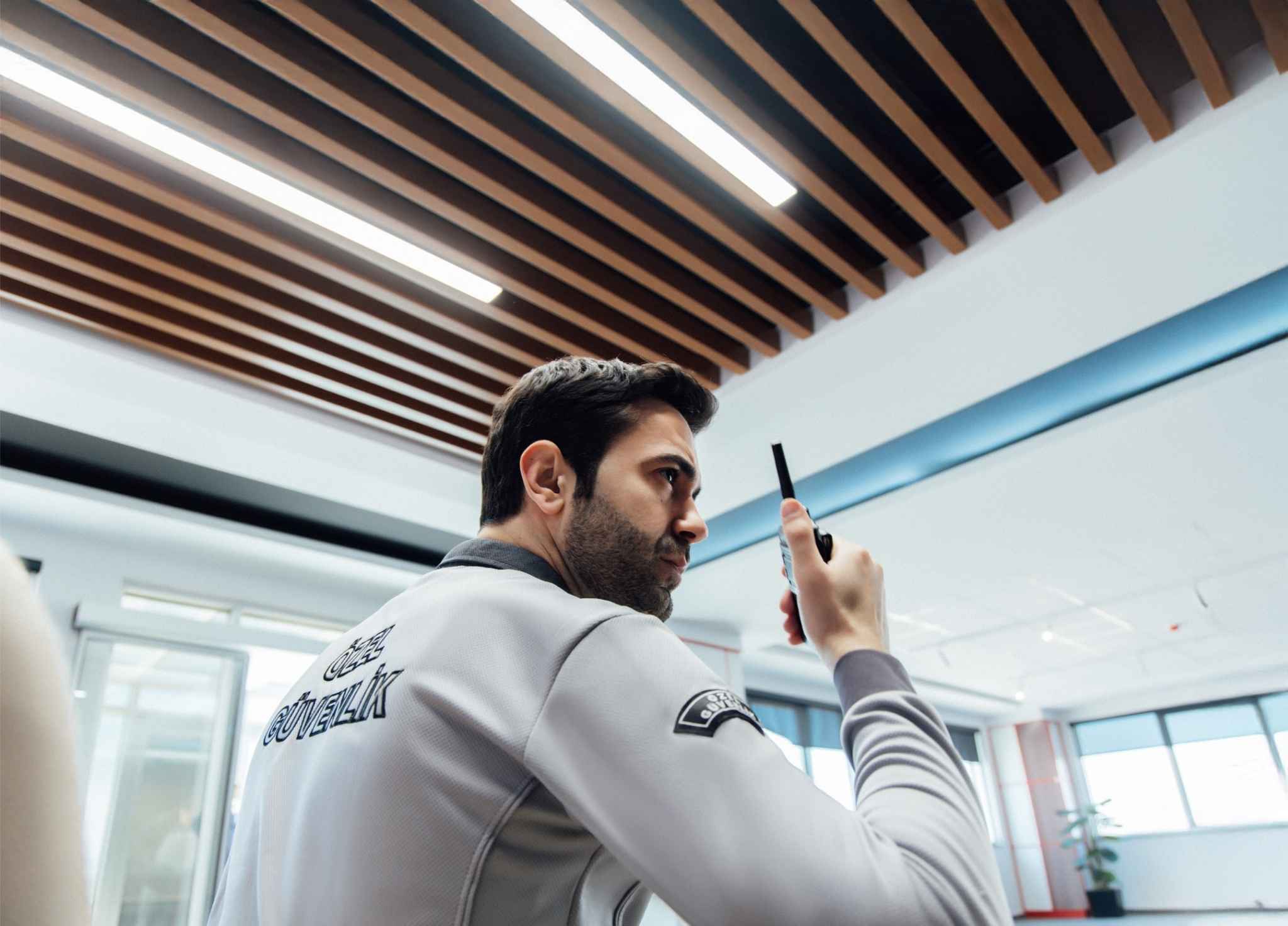
A Titan Savunma officer in a private security uniform communicating by radio inside a building.
What criteria should decide between security firms in Muş?

The starting point is the legal licence: check that the firm can document its Ministry permit. Then put one identical questionnaire to every shortlisted firm and insist on replies on paper. Put these on it: who will head the team in Muş; on whose behalf, and how many times a month, unannounced audits will take place; which reserve covers an officer who is ill or on leave; how many people will be added at a sewing factory gate during shift change; how outdoor spells will be shortened in the January frost and the July heat; and which records the monthly report will include. Lining up answers to identical questions makes it easy to see what a cheaper quote leaves out.

Who will run day-to-day matters at our site in Muş?

Our Muş City Manager. The manager who tours your site before the quote remains your point of contact after the contract is signed: choosing the crew, writing the duty rota and calling in on the site every day. You ring that manager to have an extra gate opened, ask for an officer to be replaced or find out how a night-time incident was closed. Support comes from above as well: the Eastern Anatolia Regional Directorate joins in for plan preparation and surprise site visits, and it sets the training programme and the report template together with the Ankara General Directorate it answers to.

How does our garment factory obtain a private security permit?

The permit application is made to the Governorship of Muş in the name of the business receiving the service. It goes before the provincial private security commission, and the governor signs off the outcome; under the Regulation this should take no more than ten working days. The application explains the area to be protected, the number of officers and the reasons for each post. Our City Manager gathers the documents with you and checks the file against the list before it goes to the governorship. Public bodies follow the same route, and in their case the posts are usually also defined in the tender specification.

I want to work as a security guard in Muş: where do I apply?

Simply complete the form on our Careers page. Interviews for openings in Muş are held by our City Manager, who places each candidate according to the site that suits them, since a night shift at a factory gate and day duty in a public building call for different strengths. The conditions for entering the profession are in Article 10 of the Law: Turkish citizenship, having turned eighteen and passing the basic training exam are among them. Before duty begins, the Governorship of Muş issues the work permit and hands over the officer’s card (Law, Articles 11 and 12).

How is outdoor duty arranged through Muş’s hard winters and hot summers?

According to the meteorological service’s figures for central Muş, the January mean is −6.8 °C, the lowest temperature measured is −34.4 °C and snow has lain as deep as 163 cm. At the same station the July mean is 25.1 °C and the highest temperature measured is 41.6 °C. We therefore write two separate sets of instructions for outdoor duty. The winter set provides an enclosed booth with a stove or electric heater, coats and thermal layers worn one over another, boots with grip and changeovers more often than hourly; the summer set provides an awning, cold water and officers taking turns in the shade through the midday heat. Officers tell the business about ramps and walkways that ice over; shovelling snow and spreading salt are the business’s job.

What is the security team’s remit at a hospital and on a university campus?

Officers are responsible for protecting people and the building, letting tension die down before it grows and passing incidents to management in good time. In practice that means a fixed post at the emergency door, an ambulance bay kept free of parked cars, traffic guidance that prevents jams in the car park, checks at campus entrances under the rules the institution sets and night rounds near halls of residence and the library. Hospital admission, treatment-related guidance, disciplinary procedures for students and correspondence stay outside the team’s work. Section 8 of Law No. 5188 bars firearms at health and education institutions, so our team at these sites carries none.

How is security set up during the sugar beet intake and at livestock businesses?

At these businesses the busy periods follow the seasons, so we divide the contract into periods. During the beet intake the plan adds posts at the weighbridge and unloading yard, a separate queuing area for waiting trailers and checks on night lighting; all year round it covers gate routines timed to milk collection vehicles, perimeter rounds at feed and produce stores and enforcement of the no-flame rule against fire. Weighing, quality testing and acceptance decisions stay with the business’s own staff; the team keeps the setting safe for that work.

When fire breaks out, water rises or the lights stay off for hours, what do the guards do?

What happens at such a moment is set by a scenario written in advance. Your factory or organisation covers fire, flooding after a downpour, a snowstorm that closes the roads and hours without electricity in its own emergency document; our officers carry out the lines that document gives to security. Typically these are: releasing turnstiles and gates by hand when the power fails, taking those leaving the building to the assembly point, supporting a check against the roster of who was inside at that hour, keeping the approach clear for the fire engine and taping off damaged areas so nobody goes back in. We write a name against every line of the scenario and practise it on site in the business’s annual drill.

Request a Duty Plan and Price for Your Muş Site

In the form, just tell us what your site does, how many gates and loading bays it has, how shifts or visiting hours are organised and whether the contract will come through a tender or be signed directly. Our Muş City Manager will call to agree a convenient day for the survey, then send you in writing a duty plan and price written around your site, your production tempo and two harsh seasons.

Request a Security Proposal

Contact

Request a Security Proposal for Your Organisation

Tell us your facility type, location and general requirements. Together, we can define a service scope that suits your organisation.

Tell Us What You Need

Fields marked * are required.

What Happens Next

  1. Initial DiscussionWe respond within 15 minutes and clarify your requirements and facility details together.
  2. Service ScopeWe assess staffing needs and the working arrangements.
  3. ProposalWe prepare our proposal for the agreed service scope.

General Directorates

Ankara · Çankaya
İstanbul · Levent

Nine regional directorates · 81 provinces

Looking for a role? Visit our careers page